The 5 Questions Every Hospitality Executive Should Answer Before Approving Their 2027 Guest Experience Budget

Across the hospitality industry, corporate leadership teams are developing their 2027 strategic plans and operating budgets. Hotels, casinos, and resorts are considering investments in employee training, staffing, compensation, property improvements, artificial intelligence, automation, and new service-delivery processes.
Many of these investments will be justified, at least partly, by their anticipated impact on the guest experience.
A hotel may add front-desk coverage to reduce wait times. A casino resort may introduce an incentive program intended to strengthen service behaviors. A management company may invest in leadership development across its properties. Another organization may deploy automation to reduce administrative work and allow employees to spend more time assisting guests.
These initiatives can require significant investments, particularly across organizations with dozens or hundreds of properties. Yet after the budget is approved and the initiative begins, corporate leaders frequently struggle to answer a basic question:
Did the investment actually improve the guest experience?
The challenge is rarely a complete lack of data. Most hospitality organizations have guest surveys, online reviews, operational reports, financial results, employee feedback, and property-level action plans.
The greater challenge is governance.
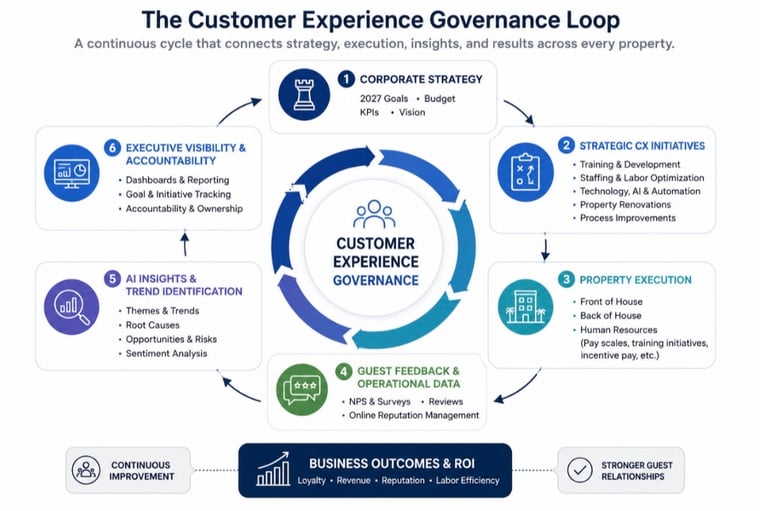
The goals may be documented in a presentation. The supporting initiatives may live in spreadsheets. Updates may be communicated through email or periodic meetings. Guest feedback may be managed in another system entirely. By the time executives attempt to evaluate the results, the original objective, the actions taken, and the resulting impact are often disconnected.
For corporate hospitality leaders, customer experience must become more than a score or a collection of guest comments. It should provide a structured way to establish expectations, assign accountability, monitor execution, and determine whether strategic investments are producing measurable results.
Before approving the next major guest experience investment, leadership teams should be prepared to answer five questions.
Question 1: What Guest or Business Problem Are We Trying to Solve?
Before funding an initiative, leaders should clearly define the problem it is intended to address.
“Improving the guest experience” is not a sufficiently specific objective.
A more useful objective might be:
- Reduce dissatisfaction associated with the arrival and check-in process.
- Improve employee responsiveness during high-demand periods.
- Reduce the frequency of housekeeping-related complaints.
- Strengthen service consistency across the portfolio.
- Improve recognition and personalization for repeat guests.
- Reduce the time required to identify and resolve service failures.
- Improve employee retention in departments with a measurable impact on service.
- Maintain guest satisfaction while introducing automation or changing staffing levels.
This level of specificity matters because different problems require different investments.
If guests are dissatisfied with room readiness, additional customer-service training may not solve the underlying problem. The organization may need to examine scheduling, housekeeping productivity, room inspection processes, maintenance, or communication between departments.
Similarly, if guests perceive employees as unhelpful, the root cause may not be a lack of effort. It could be inadequate training, unclear policies, high turnover, insufficient staffing, poor tools, or compensation that makes it difficult to attract and retain experienced employees.
A modern customer experience program allows leaders to move beyond isolated comments and identify recurring patterns across properties, departments, guest segments, and stages of the journey. The purpose is not simply to identify what guests are saying, but to understand why the issue is occurring and which business decision is most likely to improve it.
The strongest initiatives begin with a clearly articulated problem, an evidence-based understanding of its causes, and an agreement about the guest and business outcomes that should change.
Question 2: How Will We Measure Success?
Every major guest experience initiative should have defined success measures before the organization begins spending money.
Too often, leaders approve an initiative and determine how to measure it later. This creates a natural tendency to select whichever results appear most favorable after implementation.
A better approach is to establish a baseline, define the expected impact, and agree on the review period in advance.
The appropriate measures will depend on the initiative. They may include:
- Overall satisfaction
- Net Promoter Score
- Department-specific satisfaction
- Sentiment within guest comments
- Frequency of complaints about a particular issue
- Online review scores
- Repeat visitation
- Loyalty-program engagement
- Service-recovery volume and cost
- Employee turnover
- Employee engagement
- Labor productivity
- Average daily rate
- Ancillary spending
- Guest retention
- Direct-booking behavior
Executives should avoid expecting a single metric to tell the complete story. A hotel could improve satisfaction while increasing labor costs beyond a sustainable level. Another property might reduce operating expenses while damaging loyalty or online reputation.
The objective is to evaluate the relationship among experience, operations, and financial performance.
This is also where unstructured feedback becomes particularly valuable. A score may indicate that satisfaction declined, but guest comments can help identify whether the decline was driven by cleanliness, employee interactions, noise, technology, food and beverage, or another issue.
Research from Medallia involving 1,749 hotel guests and 1,905 retail consumers found a strong relationship between perceived personalization and overall satisfaction. The same research reported that only 23% of consumers experienced high levels of personalization during recent hotel stays, suggesting a meaningful gap between guest expectations and delivery. Medallia also cited earlier research indicating that 61% of consumers are willing to spend more with companies that provide customized experiences.
That does not mean every personalization initiative will generate an automatic return. It means organizations should establish a process for measuring whether the experience guests receive changes after the investment is made.
Robert Brimmer, CFO at the Venetian recently shared “guest satisfaction we view as a long-term indicator for the prospect for business is at record highs. Employee engagement, which is something we invested heavily in, is at record levels and financially our earnings are at a record level for 2025 and are on a strong growth trajectory. The investment has been great for investors and other stakeholders.”
Question 3: How Will Every Property Execute Consistently?
A strategy approved in a corporate office does not improve the guest experience. The experience changes only when the strategy is translated into actions at individual properties.
That transition from corporate intention to property execution is one of the greatest challenges in hospitality.
Every location operates in a different labor market. Properties may vary in size, service model, physical condition, demand patterns, leadership experience, technology, and guest mix. A program that is easily adopted by one hotel may be difficult for another to execute.
Execution also extends across multiple areas of the operation.
Front of House
Front-of-house teams often have the most visible impact on the guest experience. New initiatives may affect arrival, check-in, recognition, communication, problem resolution, concierge services, loyalty benefits, and departure.
Leaders need to determine whether the expected behaviors are being adopted consistently and whether guests are noticing the difference.
Back of House
Many of the most important drivers of guest satisfaction occur behind the scenes. Housekeeping, maintenance, security, information technology, culinary operations, and other support functions all influence the experience, even when guests do not interact with those departments directly.
A guest may describe a problem as “poor service,” while the underlying cause is a delayed room inspection, an unavailable part, an inaccurate system status, or a breakdown in departmental communication.
Human Resources
Human Resources plays an equally important role. Pay scales, hiring practices, onboarding, training initiatives, incentive compensation, recognition programs, scheduling, career development, and employee-retention strategies can all affect service delivery.
Hilton CEO Chris Nassetta has described team members as being at the heart of the company’s hospitality and connected the passion employees bring to work with the experiences created for guests. Hilton has also stated that investments in employee wellness, growth, inclusion, and purpose support guest satisfaction and business performance.
This relationship is especially important when organizations are changing staffing models or introducing automation. Technology may improve efficiency, but employees still need the training, tools, confidence, and authority required to create a positive guest experience.
Corporate leaders therefore need more than confirmation that an initiative was announced. They need visibility into adoption.
Did each property complete the training? Were local leaders engaged? Were operating processes changed? Did employees understand the objective? Was the initiative implemented on time? Are some properties producing stronger results than others?
Without a structured approach to execution, corporate strategies often become optional property-level activities.
Question 4: How Will Corporate Leadership Inspect What It Expects?
Peter Drucker is often credited with the principle that what gets measured gets managed. In distributed hospitality operations, another principle is equally important:
What leadership expects must also be inspected.
Inspection does not need to mean punitive audits or additional administrative work. It means creating enough visibility for leaders to know whether commitments are being fulfilled and whether the organization is making progress.
Today, many guest experience initiatives are tracked through a combination of spreadsheets, Word documents, presentations, project-management tools, email, and recurring meetings. Each tool may serve a purpose, but together they rarely provide a complete and current view.
A corporate executive may see an annual guest experience plan in January, a progress presentation in May, and year-end results in December. Between those reviews, the connection between individual initiatives and changing guest perceptions can be difficult to see.
An effective governance model should allow leadership to answer several questions throughout the year:
- Which initiatives are active?
- Who owns each initiative?
- Which properties are participating?
- What milestones have been completed?
- Which initiatives are behind schedule?
- What guest issue prompted the investment?
- Are relevant satisfaction scores improving?
- Are guest comments changing?
- Which properties are producing the best results?
- Where is additional support needed?
- Should the initiative be expanded, adjusted, or discontinued?
Customer experience platforms have evolved beyond survey distribution and dashboard reporting. Platforms such as Medallia can help organizations establish goals, distribute those goals to relevant leaders, assign ownership, track initiatives, and connect specific insights or trends to the actions intended to address them.
This creates a living system of record for customer experience rather than a static collection of annual plans.
The distinction is important. A dashboard tells an executive what happened. A governance system helps the executive understand what the organization is doing about it.
Question 5: Can We Demonstrate the Return on the Investment?
Return on investment in customer experience is not always as simple as measuring the revenue generated by a new room package or marketing campaign.
The value may appear through a combination of outcomes:
- Increased repeat visitation
- Stronger guest retention
- Higher direct-booking activity
- Greater loyalty
- Improved online reputation
- Reduced service-recovery costs
- Fewer recurring operational failures
- Greater employee retention
- Higher ancillary spending
- Reduced reliance on discounting
- Increased willingness to pay
- Better labor productivity
- More effective capital allocation
The challenge is establishing a credible connection between the initiative and the outcome.
For example, an organization may invest in additional training for front-office employees. Following implementation, satisfaction with arrival improves, negative comments about employee helpfulness decline, service-recovery incidents decrease, and repeat guests provide stronger ratings.
No single measure proves the entire financial return. Collectively, however, these changes provide credible evidence that the initiative is influencing guest perception and operational performance.
The same approach can be used to evaluate physical improvements. If guest feedback indicates that bathroom condition is a significant source of dissatisfaction, the organization may renovate a group of properties. By tracking relevant comment themes and satisfaction measures before and after the renovations, leaders gain a clearer view of whether the investment addressed the intended problem.
This is where customer experience data becomes a capital-planning and financial-planning tool rather than simply an operational scorecard.
The objective is not to claim that every positive business result was caused by a CX initiative. The objective is to build a disciplined body of evidence that helps executives make better decisions.
Why Each Executive Should Care
Customer experience governance is not solely the responsibility of a Chief Experience Officer. Every member of the executive team has a distinct reason to participate.
CEO: Turning Strategy Into Consistent Execution
For the CEO, customer experience reflects whether the organization is delivering its brand promise.
A corporate strategy can be clear, well funded, and enthusiastically communicated but still fail at the property level. A strong CX governance program gives the CEO visibility into whether strategic priorities are translating into meaningful changes for guests.
It also allows the CEO to identify where the organization is succeeding, recognize high-performing leaders, and intervene when execution is inconsistent.
Most importantly, it turns customer experience into an enterprise capability rather than a departmental program.
CFO: Evaluating Value and Protecting Investment
For the CFO, customer experience governance provides greater discipline around major operating and capital decisions.
Training, staffing, compensation, technology, renovations, and automation all require funding. Finance leaders need to understand the assumptions behind those investments and whether the expected operational or guest outcomes are being achieved.
A structured CX program can help finance teams compare projected benefits with actual changes, identify underperforming initiatives earlier, and redirect resources toward programs producing stronger results.
The goal is not simply to reduce spending. It is to improve the return generated by each dollar invested.
CMO: Ensuring the Experience Fulfills the Brand Promise
Marketing creates expectations. Operations determines whether those expectations are fulfilled.
A compelling campaign may attract a first-time guest, but the experience influences whether that guest returns, recommends the property, joins the loyalty program, or books directly in the future.
For the CMO, customer experience data provides a view into how guests interpret the brand after the marketing message ends. It can identify differences between the intended brand position and the experience delivered at individual properties.
It can also reveal which attributes matter most to valuable guest segments, helping marketing leaders develop more relevant communications, offers, and loyalty strategies.
COO and VP of Hospitality: Improving Operational Consistency
For operations leaders, the central challenge is consistency.
The objective is not necessarily for every property to operate identically. The objective is to ensure that each property delivers the expected level of service and addresses its most important guest pain points.
A corporate CX program allows operations leaders to compare performance, identify recurring issues, share best practices, and determine where local leadership needs additional support.
Rather than reacting to isolated complaints, they can prioritize the issues affecting the greatest number of guests or creating the greatest operational risk.
Chief Experience Officer: Moving From Measurement to Action
For the CXO, the challenge is often not collecting more feedback. It is ensuring that the organization acts on what it already knows.
A mature customer experience program should connect listening, analysis, accountability, execution, and results. That requires collaboration across Operations, Marketing, Finance, Human Resources, Technology, and individual properties.
The CXO can use a governance framework to ensure that insights are assigned to owners, initiatives have measurable goals, and executives receive visibility into progress.
This moves the function from reporting scores to influencing strategic decisions.
Chief Human Resources Officer: Connecting Employee Investment to Guest Outcomes
Employees deliver hospitality. Investments in recruitment, compensation, onboarding, training, leadership development, recognition, and retention should therefore be evaluated partly through their effect on service delivery.
For HR leaders, customer experience data can help identify whether workforce investments are changing guest perceptions.
It may reveal that properties with lower turnover achieve better service scores, that a new training program reduces specific complaints, or that employees need more authority and resources to resolve guest problems.
This helps HR demonstrate its direct contribution to brand performance and customer loyalty.
Financial Planning and Analysis: Creating a Continuous Feedback Loop
Annual plans are built using assumptions. FP&A leaders need mechanisms for testing those assumptions throughout the year.
A customer experience governance program creates a continuous feedback loop between the budget, operational execution, guest perception, and business performance.
Instead of waiting until the next planning cycle, FP&A teams can identify whether an initiative is producing the expected results and update forecasts accordingly.
This is particularly valuable for multi-property programs where performance may vary significantly by location. The organization may choose to expand an initiative at successful properties, modify it where results are weaker, or discontinue it when the evidence does not support further investment.
From Guest-Feedback Program to Executive Governance Platform
Many organizations still view customer experience technology primarily as a survey platform. That definition is increasingly incomplete.
A modern CX platform should help an organization collect feedback, analyze unstructured comments, identify trends, distribute insights, establish goals, assign ownership, track initiatives, and monitor the resulting impact.
Medallia is the platform ComOps recommends because it can support this broader approach to customer experience management. However, technology alone does not create governance.
Organizations also need a clear operating model:
- Executive alignment around the most important objectives
- Defined ownership of CX initiatives
- Consistent measures across the portfolio
- Property-level accountability
- Processes for reviewing insights and taking action
- Integration with financial and operational planning
- Ongoing evaluation of results
ComOps supports organizations across all three dimensions.
As a CX strategy advisor, we help executives define the outcomes they want to achieve and assess the current maturity of their customer experience program.
As a Medallia implementation and optimization partner, we help configure the platform to provide relevant insights, goals, workflows, and reporting to each level of the organization.
As an executive governance partner, we help leadership teams build the processes needed to turn insights into action and evaluate whether initiatives are producing results.
The objective is not simply to deploy software. It is to create a more effective connection between corporate strategy, property execution, guest perception, and business performance.
The Organizations That Win May Not Be the Ones That Spend the Most
Hospitality organizations will continue to invest heavily in service, employees, technology, automation, and physical improvements.
Some of those investments will produce meaningful benefits. Others will be well intentioned but fail to address the real problem. Many will produce different results across different properties.
The organizations that outperform will not necessarily be those that spend the most.
They will be the organizations that can clearly define the problem they are solving, establish how success will be measured, ensure consistent execution, inspect progress throughout the year, and demonstrate whether the investment created value.
Guest experience should not be managed through an annual presentation and a collection of disconnected spreadsheets. It should operate as a continuous governance cycle that connects strategy, initiatives, execution, feedback, insights, accountability, and results.
As hospitality leaders finalize their 2027 plans, the most important question may not be how much the organization intends to invest in improving the guest experience.
It may be whether leadership will have the visibility needed to know if those investments worked.
ComOps helps corporate hospitality leaders assess their current CX capabilities, align stakeholders around measurable priorities, and build governance programs supported by Medallia. The conversation begins with understanding the outcomes your organization wants to achieve—not with selling software.